

An Emma Impossible Not to Love

By Kate Hamill, based on the novel by Jane Austen
Review by Anthony Chase
Through October 4, 2026 • Irish Classical Theatre Company

Jane Austen predicted that Emma Woodhouse would be a heroine whom no one but Austen herself would much like. Two centuries later, readers have proven her gloriously wrong. Published in 1815, Emma is Austen’s most technically daring novel, a comedy of self-deception told largely from inside the head of a young woman who misreads nearly everyone around her, including herself. It has inspired several film, television, and stage versions, most famously Amy Heckerling’s Clueless, which relocated Highbury to Beverly Hills.
No contemporary playwright has staked as much on Austen as Kate Hamill. An actor-turned-playwright, Hamill first made her name with a scrappy, exuberant Sense and Sensibility for New York’s Bedlam company, a production on which Buffalo’s Irish Classical Theatre Company closely modeled its own 2019 staging. Hamill starred in the original production and has since become one of the most produced playwrights in America.
Her signature is by now unmistakable: small ensembles playing multiple roles, actors doubling across gender and age, direct address to the audience, and a joyfully feminist lens that makes the economic and social constraints on Austen’s women impossible to ignore. She has described her approach as scribbling on an altar with crayon, and she means it as a compliment to the altar. Emma, commissioned by Minneapolis’s Guthrie Theater and premiered there in 2022, is her fourth Austen adaptation, following Sense and Sensibility, Pride and Prejudice, and Mansfield Park, and she bills it, fittingly, as a feminist screwball farce.
Emma Woodhouse is clever, educated, energetic, and in imminent danger of going mad with idleness. She needs a project, and she prides herself on matchmaking, much to the chagrin of her friend Mr. Knightley. But wherever Emma turns her attention, tangled hearts and comic mayhem follow close behind. Kate Hamill’s adaptation once again gives an Austen classic a fresh, feminist jolt, breaking down convention and expectation, even breaking the fourth wall, with vibrant comic flair. The result, at Irish Classical Theatre Company, is a jewel of a production, with an acting ensemble that tells this story with the swift precision of a well-tuned watch.
As Keelie Sheridan’s tenure as artistic director winds toward its close, this stunning production serves as a reminder of exactly what the company will lose. Every element on that stage, from the deftly managed in-the-round staging to the smallest embroidered flower on a costume, has been meticulously calibrated, and Sheridan’s direction keeps a nimble cast moving with the clean choreography of a dance.
Penelope Sergi plays Emma, and she is luminous. Indeed, she is a star, announcing her character with her face before she says a word, and she would be right at home in this role at the Shaw Festival or on Broadway. I first took real notice of Sergi when she slayed as Hope Cladwell in the Second Generation Theatre production of Urinetown, and I believe that’s the first time I called her “luminous.” There is a delicate upturn to her nose, almost sprite-like, that gives her that particular Emma Woodhouse quality: a woman perpetually pleased with her own cleverness, forever on the verge of a private joke. Combined with expressive dark eyes, an arch brow, and a mouth quick to curl into a knowing half-smile, it is a face built for matchmaking mischief.
Sergi’s Emma has no poker face at all; the actor fashions a woman incapable of hiding her thoughts or feelings, playing Emma’s schemes with visible delight. Here is a young woman, handsome, clever, and rich, who has never once doubted her own judgment and is thoroughly entertained by her own wit. It is a performance that understands Emma’s central paradox: she has to be genuinely charming, or her blind spots and casual cruelties would curdle the whole play. Her comeuppance and repentance are, of course, delightful.

Emma’s favorite project, Harriet Smith, finds a lovely match in Timiyah Love, who plays her as breathless and guileless, a young woman built almost entirely out of other people’s opinions, the perfect pigeon for Emma’s matchmaking machinations. It is a performance with real pathos underneath the comedy: Love plays Harriet’s lack of self-confidence not as simple ditziness but as a kind of learned helplessness, a girl who has never once been asked what she wants. That makes her late-play assertiveness, emboldened by the very romantic trials Emma put her through, feel genuinely earned.
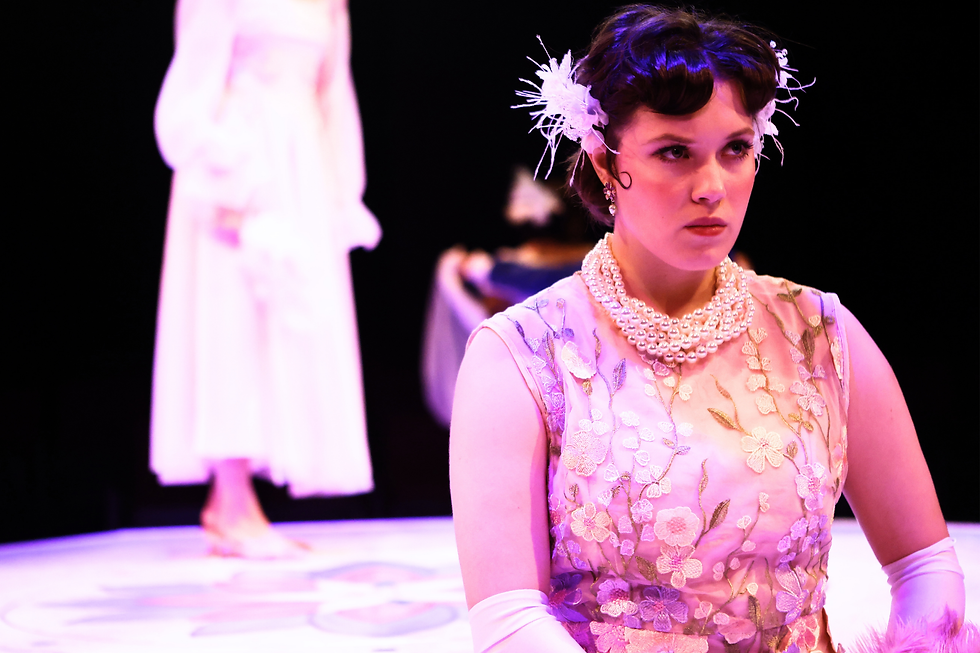
As Jane Fairfax, Emma’s quiet rival in accomplishment, Julia Cianfrini makes an auspicious ICTC debut in a leading role, embodying the character as a model of dignity and restraint. Jane is a tricky creation, carrying a secret and genuine suffering while remaining outwardly composed, likable enough that the audience feels for her, reserved enough that Emma’s jealousy makes sense. Cianfrini finds that balance, playing the character’s mystery and long-suffering patience with a quiet gravity that never tips into melodrama. In a nice bit of doubling, Cianfrini also appears as Mr. Elton’s socialite wife, broadly and farcically comic, a performance so different from Jane’s restraint that it also serves as a demonstration of range.

Opposite Emma, Alejandro Gómez’s George Knightley is dashingly handsome and, more importantly, decent. Knightley is Austen’s moral compass, the only person in Emma’s life willing to tell her when she is wrong, and Gómez plays that plainspokenness with real warmth rather than sternness. He suffers for love with dignity and humor, letting Knightley’s slow-dawning feelings for Emma read clearly to the audience well before Emma catches on herself.

If Knightley is the production’s moral center, Jeremy Kreuzer supplies a comic engine, doubling as both Mr. Elton and Frank Churchill in a performance that confirms him as a true comic genius and a master of transformation. His big eyes carry much of the storytelling, registering vanity, calculation, and barely suppressed desire often before a line of dialogue catches up to them, and his undulating physicality lends both Elton’s oily self-regard and Churchill’s restless charm a nearly volcanic libido. It is a performance that finds the comedy in two very different species of male self-interest without ever letting the two men blur into one another.

At home, Emma’s world is anchored by Peter Horn’s Mr. Woodhouse, dryly, deliciously funny, milking more comic mileage out of a bowl of gruel than should reasonably be possible. Austen’s Mr. Woodhouse is a fussy hypochondriac, terrified of drafts, rich food, and any disruption to his routine, and Horn plays that anxiety with a deadpan precision that keeps the character endearing rather than simply irritating, finding the love underneath the fretfulness. I also enjoyed his unexpected appearance in drag, the details of which I won’t spoil for you.

Sara Kow-Falcone is the consummate ensemble player. As Mrs. Weston, she serves as the production’s voice of reason, much as the character does in the novel: the former governess whose own happy, sensible marriage quietly undercuts Emma’s more chaotic matchmaking schemes. Kow-Falcone’s steady, warm presence anchors the scenes around her, and the costume design gives her one of the show’s best running sight gags, a pregnancy that keeps growing scene by scene, tracking the passage of time with sly visual humor.

Rounding out the ensemble, Diane DiBernardo is darling as the well-meaning Miss Bates, Austen’s endlessly talkative, poor, kind-hearted spinster, whose casual mistreatment at Emma’s hands becomes the novel’s moral turning point. Long one of Buffalo’s most reliable actors, DiBernardo delivers yet another finely judged and affecting performance. She finds both the comedy in Miss Bates’s chattering and the real hurt underneath it, which makes the play’s final scene all the more satisfying, when Emma, at her own wedding, makes amends. DiBernardo’s elation is a joy to behold.

Collin Ranney, who designed sets, costumes, and hair and makeup, has built this Emma like a well-tended garden: everything drawn from a single, disciplined palette, yet rendered in constant variation so that nothing repeats itself. The floral motif is everywhere: as pattern, in printed fabrics; as texture, in eyelet lace, appliqué, and cutwork sleeves; as ornament, in the garlands of silk roses and cherry blossoms that frame the stage overhead, turning the playing space into something like the underside of a trellis; as painted detail, in the stenciled roses on the stage floor itself, their blue and pink blooms echoing the garlands above.
Ranney also plays cleverly with scale, dotting the stage’s four corners with a miniature, garlanded Highbury, tiny nineteenth-century houses that turn the whole in-the-round space into a dollhouse version of Austen’s England. E.L. Hohn’s props design complements that world beautifully; in the strawberry-picking scene, gargantuan berries share the stage with life-sized fruit.
The palette itself does the unifying work. Blush, rose, sage, cream, and the occasional jolt of rust or gold keep every scene visually related to every other scene, while establishing character and social class, so the world never fractures even as locations shift rapidly across this demanding in-the-round staging. The closer a character is to the working class, the brighter the colors and the coarser the textures of the fabrics.
What is especially clever is how Ranney uses costume as a quick-change storytelling device. The base garments stay simple (a fitted bodice, a plain coat) so that sleeves, collars, bows, and outer layers can be swapped to indicate a new character, a new social occasion, a leap in time, or even a change of gender, without requiring a full costume change. A floral-patterned waistcoat, glimpsed beneath an olive wool tailcoat, marks a gentleman as fashionable without ever shouting it. A woman’s practical bonnet and round spectacles, paired with a sensible woven purse, read instantly as a different social register from the silk and pearls of a ballroom scene. The costumes are beautiful, but they are also doing structural work, letting a small company move fluidly between roles and scenes without ever confusing the audience about who is who.
Jayson Clark’s lighting design punctuates the proceedings with equal finesse, transporting us indoors and out, from daylight into night; as the production reaches its romantic climax, the stage blazes. Nick Quinn’s sound design underscores the action while maintaining the production's elegant, if comic, tone.
Austen feared no one but she would much like her heroine. Two centuries later, Hamill, Sheridan, and a radiant Penelope Sergi have given us an Emma impossible not to love. She leaves Highbury on Sunday, October 4. Don't let her get away.


