

Elvis in Drag: Performing ‘Normal’ in The Legend of Georgia McBride

Updated: Jun 8
REVIEW
By ANTHONY CHASE

Matthew López’s The Legend of Georgia McBride initially presents itself as something like a 1970s television sitcom. Think Three’s Company with a drag twist. Casey, an Elvis impersonator facing a financial crisis, turns to drag performance to survive, concealing this new career from his wife. Misunderstandings and comic complications ensue. Surrounding him are two seasoned drag performers, the imperious Miss Tracy Mills and the acerbic Rexy, tasked, reluctantly, with shaping this unlikely newcomer.
The jokes are rapid and effective. But this is not, in fact, a sitcom.
Beneath its farcical machinery, López’s play is engaged in a more searching inquiry into identity, specifically, identity as something performed, rehearsed, and sustained under pressure. Torn Space Theater’s framing makes this explicit: Casey’s crisis is not simply economic but ontological. As his Elvis act collapses, so too does his sense of self. The masculinity he has been “performing,” and at which he has been failing, is no less constructed than the drag persona he resists.
Yet even this does not fully account for the play’s deeper current. Running beneath the comedy and the performance discourse is a more volatile force: shame.
Miss Tracy Mills and Rexy occupy a world in which drag is not aberrant but normative, a space where identity, however stylized, is lived without apology. Casey, by contrast, is paralyzed by the fear of exposure. He cannot bring himself to tell his wife how he is earning a living. At first, when the husband who had, just days ago, spent the rent money on pizza shows up with fists full of cash, she suspects he has done something illegal. His crisis is not merely about adapting to a new form of performance, but about confronting the shame attached to it.
Rexy’s experience throws this into stark relief. She recounts being brutally attacked while leaving work in drag at the age of sixteen, beaten, hospitalized, and yet undeterred. She returns to work, walking to her car in full drag night after night. Where Casey retreats into concealment, Rexy refuses it. If Casey’s trajectory is defined by shame, Rexy’s is defined by its rejection.
This dynamic resonates with queer theory that positions shame as central to queer experience, not only as a product of stigma and marginalization, but as a generative force. Resistance to shame, in this framework, can produce imagination and alternative modes of belonging. The drag world of Georgia McBride becomes precisely such a counterpublic, a space where stigma is inverted and reconstituted as community. The contradiction for Casey, or Georgia, is that the stigma of not being man enough to provide for his growing family is supplanted by the stigma, perceived by him but not by Tracy and Rexy, of being a man in a dress.

In contrast, Rexy shows little awareness of, or interest in, the compulsive nature of Casey’s devotion to his Elvis persona. Jo, his wife, understands this all too well. Like drag queens who forgo food for finery, Casey has ignored household bills in order to expand his Elvis wardrobe. And while he happily impersonates the King in public, he is too afraid of rejection to perform his own original music. Elvis, here, is its own form of drag.
From this perspective, the play is not simply about transformation or self-acceptance. It is about the instability and provisional nature of the “normal” itself. What Casey experiences as deviation is, within his new community, the norm. And what he has understood as natural, his masculinity and his heterosexual domestic life, is revealed to be equally constructed, equally performed. The irony is that he was a failure in his masculine persona, but experiences great success in his drag persona. Casey comes to understand this pointedly. Georgia, he observes, is reliable. She would never bounce the rent check for a pizza.
López traces this trajectory through Casey’s performance lip synching to Edith Piaf’s “Padam, Padam.” At first, he is clumsy, self-conscious, and very much merely a man in a dress. Through successive performances, he more fully embodies the femininity of the role. Miss Tracy Mills is keen that he find the appropriate drag persona, stressing that despite its performative nature, the drag persona must come from within if it is to have authenticity.
Directed by Torn Space artistic directors Dan Shanahan and Melissa Meola, the production was originally incubated within the imagination of Buffalo United Artists, a theater dedicated to queer experience, and the cast largely boasts a BUA pedigree. BUA founder Javier Bustillos (and yes, my husband) served as producing consultant. Torn Space lives to amplify the unstated underpinnings of scripts. Their expressionistic rendering of Tennessee Williams’s A Streetcar Named Desire and their stage interpretation of John Cassavetes’s The Killing of a Chinese Bookie are among my life’s theater-going highlights. Here, they join forces with some of Buffalo’s most divinely talented and accomplished queer artists to reveal the brilliant underpinnings of López’s play.

Jimmy Janowski, an undisputed star of Buffalo theater, portrays outrageous yet wise Miss Tracy Mills, bringing both playful lunacy and practicality anchored by necessity to the role. The entire action of the play pivots on this performance, as Miss Tracy Mills serves as guide, interpreter, and moral compass for all that transpires.
Anthony Alcocer is unaffectedly wonderful as Casey, the hapless Elvis impersonator. Through Elvis, Alcocer evokes a very specific fantasy of American masculinity: a working-class Southern boy who is effortlessly sexual, charismatic, and “authentically” male, yet still boyishly vulnerable and charming. Elvis, after all, is a man whose desirability is coded as natural rather than constructed. In Casey’s world, that fantasy seems to promise that simply putting on a jumpsuit and thrusting your hips should be enough to access a prepackaged, idealized version of manhood. But it is not. It is at this moment of heteronormative failure that Alcocer’s own boyish vulnerability and charm buoy the performance into something affectingly real.
Mike Blasdell, aka Bebe Bvlgari, is one of the region’s most acclaimed drag artists, who has in recent years become equally celebrated as an actor. His performance as Rexy, who veers wildly from intoxicated obliviousness to unfocused rage to the precision of intellectual insight focused by rage, is inspired. His drag performances are delicious.
Annette Daniels Taylor gives an exquisitely paced and modulated performance as Eddie, making a fully articulated subplot of her journey. Her succession of holiday-themed drag show introductions is particularly enjoyable.
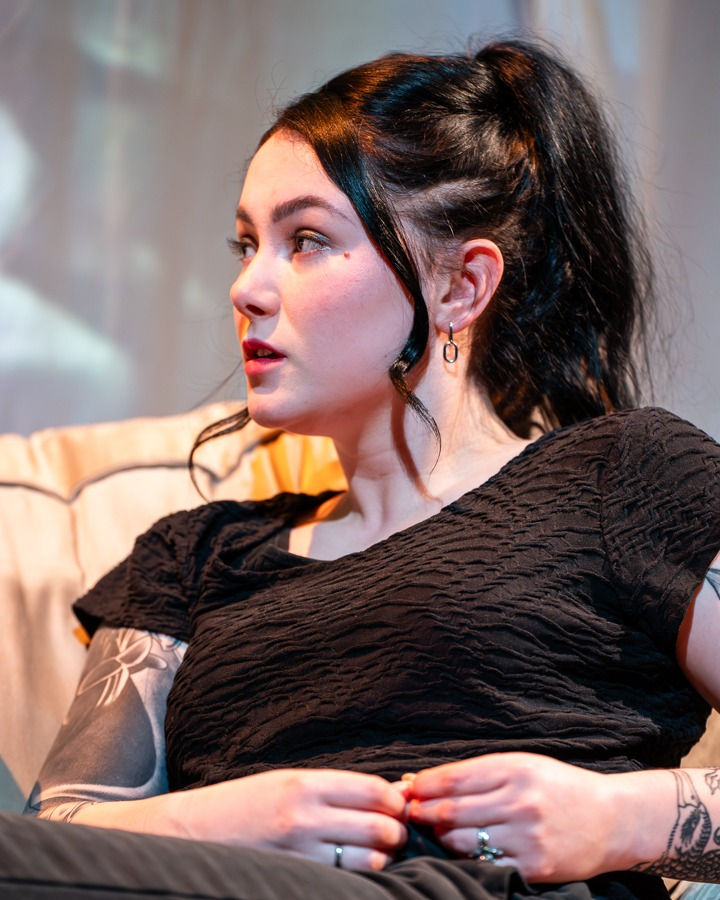
Sweetly affecting as Jo, strong-willed and long-suffering wife of a very flawed man, Christine Turturro hits critical plot points with ease. The only total grown-up in the play, Jo is initially relegated to the periphery of all the action. This will pivot abruptly, and Turturro exploits the moment for all it is worth.
Finally, Michael Seitz, BUA’s perennial leading man, plays Jason, friend and landlord to Casey and Jo. His forays into personal recollections and recounting of interactions with his off-stage wife are hilarious. He scores one of the night’s biggest laughs merely by observing, with casual nonchalance, that the show must go on.

Design is one of the hallmarks of any Torn Space show. Here, scenography by Kristina Siegel, lighting by Matvey Kitchen, and video by Brian Milbrand lend the production the familiar Torn Space Theater touch of expressionism, as video reinforces and contradicts the action on stage. This is a continuous barrage of cultural commentary projected onto the back and proscenium of an industrial expanse, augmented by Justin Rowland's sound design. Siegel (whose history includes work at the famed Berliner Ensemble) has, appropriately, positioned the action in and around an expansive performance space.

Taylor’s Eddie, already noted for her exquisitely paced and modulated performance, also shifts power, authority, and cultural coding in the room. An African American woman who owns a business and comes from an apparently mixed-race family, she initially views the prospect of drag as an opportunity to exploit family for financial advantage. As the gamble begins to pay off, and handsomely, she begins to reshape her own persona, finding ways to perform more outrageously as she grows comfortable with the new normal of her workplace. Taylor even finds ways to hit some pointedly lesbian notes in her performance as Eddie. Financial security certainly gives these characters the power to secure their normal.
More than escapist, the drag performances in this production are demonstrations of mastery within an ostensibly stigmatized form. Jimmy Janowski, a master entertainer and miner of popular culture, boldly launches into some of the world’s most familiar drag icons, linking Cabaret-era and contemporary Liza Minnelli, tap-synching as Ann Miller, and over-emoting as Barbra Streisand. In each case, he creates an entirely new and fabulously, ridiculously brilliant comment on their icon status. These performances invite us to recall similarly brilliant Janowski turns with Buffalo United Artists, taking on Susan Hayward in Valley of the Dolls, Lana Turner in Imitation of Life, Joan Fontaine in Rebecca, Tippi Hedren in The Birds, and multiple appearances as Joan Crawford. Janowski’s drag performances function as camp transgression, and therefore as a rejection of respectability politics tied to shame. His very first appearance as Liza, in a wheelchair, sets the tone. Oh yes. We will be going there.

Mike Blasdell’s numbers in particular, including his performance of Shirley Bassey’s “This Is My Life,” are especially powerful in this regard, particularly when juxtaposed against footage from the 1990 documentary Paris Is Burning. Considered alongside Rexy’s tirade, directed at Casey, about the meaning of drag, those moments deepen the production’s argument about drag as both survival and assertion.
In time, Alcocer’s decided masculinity becomes the very element that gives power to his performances in a female persona. Being the man in a dress is not a gag or an object of ridicule in the manner decried by critics like Christian Lewis. It becomes an affirmative statement as he embraces his inner Georgia McBride through a sonic landscape that, as director Dan Shanahan describes, "collides female hip-hop bravado, feminist punk, and club culture, an embodied, bass-driven counterpoint to the production’s more traditional musical numbers, allowing him to bridge the divides between Elvis, Georgia, and himself."
The normal articulated in the circumstances we encounter as the play begins is bleak: a heterosexual couple failing professionally and financially; a struggling business owner; two down-and-out drag performers, one with a drinking problem, arriving at a relative’s establishment in a last-ditch effort to pull things together.
Nobody benefits from maintaining this normal. Once it is revealed to be unstable, provisional, and performative, everyone is liberated by its collapse. This is a play that exposes “normal” not as a stable category, but as a performance enforced by shame, and undone by those who refuse it.


