

A Skull in Connemara at Irish Classical

Updated: Feb 14
Exhuming the Truth
Review by ANTHONY CHASE
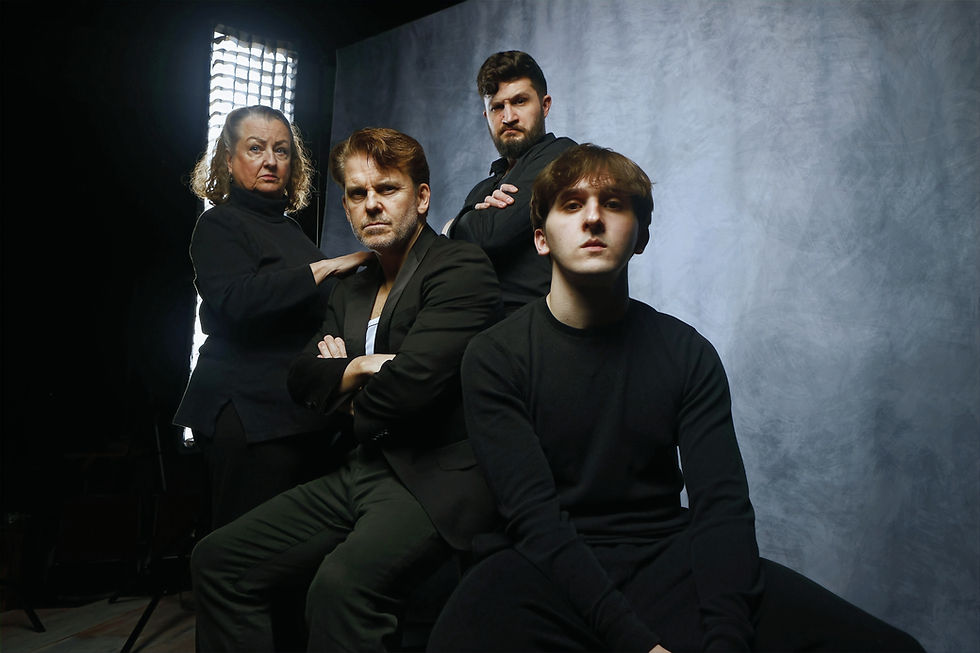
Martin McDonagh's A Skull in Connemara is a play built on deception. Every character lies. Every character keeps secrets. The current Irish Classical Theatre Company production, directed by Mason Beggs, taunts us with the performances that four rural West Ireland townspeople give for each other and for themselves -- exaggerations, distortions, manipulations -- each trying to control the narrative and carve out a path to happiness. As in so much Irish drama, that destination will prove elusive.
The official story: Mick Dowd's wife, Oona, died in a car crash seven years ago. The unofficial story, whispered by everyone in town: Mick killed her and staged the crash to look like an accident. He admits to drunk driving but firmly denies ever hurting Oona intentionally. Others have their doubts. Still, everybody gets along. After all, in this world, gruesome death is not an especially noteworthy event.
The order of things is disrupted because of the requirements of Mick's job. Each autumn, he is hired by the parish to dig up older graves in the overcrowded cemetery to make room for new ones.He must disinter the bones, remove or destroy skulls and larger remains, and rebury or dispose of them so the plots can be reused. The job is limited to one week a year, but it's central to Mick's identity in the village and to the plot, because this year Mick must exhume his wife Oona's grave. Old rumors rise back to the surface.

Sharp-tongued and heavy-drinking Mick is played by Broadway veteran Robert Creighton, a compact James Cagney of a man. I must have seen him countless times, including at least ten performances as Durdles, the gravedigger, in Edwin Drood when Chita Rivera was Princess Puffer. Once, I think I saw him chosen as the murderer, having offed Edwin Drood in a booze-fueled overreaction to a supposed apparition, played for macabre comedy -- an eerie precursor to his performance in A Skull in Connemara, in which he is a gravedigger who may or may not have committed murder.
For someone who has spent so much of his career under the bright lights of the Great White Way, Creighton makes a bold and utterly convincing choice, rendering Mick strikingly unstarry, and all the more riveting for it. He creates a man who has grown used to being watched and judged, and who responds not with bravura but with exhausted irritation. There is a weary musicality to his repeated denials, and he navigates the ambiguities of the man's truthfulness and morality with ease. When Mick drunkenly confesses to a murder he hasn't actually committed, Creighton finds the tragic undertone within the dark comedy: this is a man desperate to be guilty of something he can name, rather than forever half-guilty of something he can't. In the next instant, he quickly pivots and exudes boyish mischief as he burns his incriminating admission.
While Creighton's deft and sprightly performance is exquisitely nuanced and even poignant, he does not overpower or overshadow his fellow cast members in this perfectly calibrated ensemble.

Pamela Rose Mangus plays Mary Rafferty, a hard-drinking woman in her 70s who is a living archive of Connemara history in the form of gossip. She serves as the production's interfering engine of memory, visiting Mick's cottage to drink his booze and stir the pot. She knows things. She cares about things. She presses Mick to tell the truth about how he disposes of the bodies in the old graves. He lies to her; she knows he lies. Mangus embodies Mary's contradictions: the genuine loneliness that drives her to Mick's cottage night after night, and the relish with which she presses him for information once she's there. Mangus grounds the character's comic intrusions in a humanity that makes her a kind of moral compass for the proceedings.

Mairtin Hanlon, a late-teen village troublemaker played by Phineas Goodman, is Mary's grandson and Mick's assigned helper in the graveyard. He serves as a hyperactive, competence-challenged sidekick, energetic, foul-mouthed, and impulsive, with a mix of naive sweetness and casually sadistic humor. Goodman leans into the character's barely-house-broken energy without losing his vulnerability and showcases his manic disorder with breathlessly deceptive precision. His tall tales, including an infamous hamster anecdote, could easily repulse us; Goodman pitches them as performances Mairtin is giving for himself as much as for anyone else, a way of trying on the role of hard man in a world that offers few other costumes. He lands each tale and joke with a flourish of sprezzatura, one after the other, expertly deploying an air of nonchalance that conceals his artistry and makes everything he says or does seem uncontrived and effortless.

And finally, we meet Thomas Hanlon, played by Brendan Didio. He is Mairtin's older brother and the local Garda, a small-town policeman with more ambition than ability. Rather than a mere buffoon, Didio creates a man whose ambition outruns his competence, and whose moral compromises are less the product of evil than of a deep, petty insecurity. His insistence that he is merely doing his job, even as we come to understand his complicity in some darkly disturbing shenanigans, resonates neatly with timeless anxieties about institutional authority. Didio presents the face of the state in rural Connemara as a slightly panicked young man desperate for promotion. He's overeager to prove himself as a detective, seeing clues and conspiracies everywhere, especially around Mick's role in Oona's death, yet his self-serving incompetence and occasional doltishness make him as comical as he is threatening. And as we all know, if the gentleman doth protest too much, might he not be guilty himself?
The production amplifies these questions by making its literary antecedents visible. Director Beggs begins his play as Shakespeare began Hamlet, with a ghost. The ghost of Oona Dowd, whose untimely death haunts this story, makes pointed appearances at certain junctures, silently amplifying unanswered questions as the only known witness. How can we look at Mick standing in a grave and hefting a human skull as he contemplates mortality without thinking of the gravedigger scene in Hamlet? Both Hamlet and A Skull in Connemara use the graveyard as a truth-testing ground. Skulls become props for black humor and reflection at once, turning macabre objects into theatrical toys.
In both works, a possible murder inside a family generates the plot: Claudius may have killed King Hamlet; Mick may have killed Oona. Neither play ever supplies a fully verifiable account. We have ghosts and a play-within-a-play in Hamlet; we have rumors, missing bones, and a quartet of characters all engaged in deceptive performances of themselves in McDonagh. Did Mick love Oona? Did Hamlet love Ophelia? He says he did once; he says he didn't; he says he does. Truth is elusive.
And when a supposedly murdered man makes a comical return with a grotesque head wound (as happens in this play), how can we not think of Christy Mahon's father angrily and hilariously making his identical entrance in Playboy of the Western World? The verbal swagger of John Millington Synge's rural talkers finds an afterlife in McDonagh's western Ireland: Mairtin's grotesque hamster story, Tom's puffed-up professionalism, Mary's needling gossip all resonate with Playboy's exuberant, self-mythologizing speech. McDonagh both inherits and satirizes that tradition, and this production mines it for every golden nugget.
Collin Ranney's set design rises to multiple challenges to evoke the world of a play that is both macabre and comical. The stage at Irish Classical Theatre is an in-the-round space with audience on all four sides and has no basement; yet this is a play that demands distinct locations and digging in open graves. Ranney responds with a raised plank platform that serves, in scene one, as Mick Dowd's modest cottage and, in scene two, as the windswept graveyard. The transformation is elegant; the geography remains legible from all sides, and when Mick and Mairtin start shoveling dirt out of the trap doors, the illusion is both whimsical and startlingly effective. The grayscale palette, weathered wood, and costumes (also by Ranney) drained of almost all warmth establish a visual bleakness that tweaks the "Irish gloom" cliché while also establishing lived-in erosion, a landscape where color has been leached away by time, gossip, deprivation, and inhumanity.
Derek Heckler's lighting design sharpens that bleakness into something actively menacing yet lonely. In Connemara, it seems, the weather is always some variation on cold and miserable. "We had no summer," laments Mary, as the play begins. "Rain, rain, rain, rain, rain, we had. And now the cold. And now the dark closing in." Note in Act II the long and lonely shadow of a stark and invisible window stretched across the floor like a rug at end of day.
Every so often, at critical moments, Heckler startles us, making Ranney's plank platform glow from below, as if the floor itself were backlit by bone dust and old secrets. The light literalizes the horror, gently nudging us toward a sense that the ground is surging with the restless dead.
The props work is crucial here, and Diane Almeter Jones rises to the nightly challenge. The skulls must withstand handling, then convincingly shatter under Mick's hammer. Each crunching impact is a tiny special effect in service of character and theme: the care or carelessness with which Mick handles each skull and bone tells us as much about his relationship to the dead as any monologue could. The skull-smashing sequences are properly appalling, but they are also games, boys at play with hammers and bones, and the production captures that double register. (ICTC's investment in mulch and plaster of paris must have been substantial.)
Mason Beggs has conceived a total experience. From the moment we enter the theater and encounter a ghost who is oblivious to our presence, until Mick’s final moment with Oona fades into blackness, this production places A Skull in Connemara precisely where it belongs: at the crossroads of Hamlet's graveyard, Synge's shebeen, and McDonagh's mythologized rural Ireland. Beggs and his company have made something delicious: a production that is both theatrically inventive and emotionally honest. We will come to understand that McDonagh's real subject is how impossible it is to exhume a clean truth from a grave full of other people's stories. This tale of murder, maybe murder, and not‑quite‑murder is a bleakly funny, intelligently haunted night in the theater.
TICKETS/SHOW INFORMATION
A Skull in Connemara will be performing Friday, February 13 through Sunday, March 1, 2026. 3 weeks only! Curtain times are 7:30pm for Thursdays, Fridays, and Saturdays; and 2pm for Saturday and Sunday Matinees.
Tickets are $45 and can be purchased online at www.irishclassical.com, by phone at 716-853-4282 or in person at the ICTC Box Office. See Box Office hours on ICTC’s website.


