

Irving Berlin's White Christmas the Musical

Updated: Dec 9, 2025
Irving Berlin's Glorious Song Catalog Triumphs in MusicalFare's Sparkling Production
By Anthony Chase

Sometimes when I see a show (and sometimes even before I see a show) people are eager to help me form my opinion. Such is certainly the case with the current MusicalFare production of Irving Berlin's White Christmas the Musical, a title that is a one-line sales pitch if I ever heard one. I'm waiting for Jerry Herman's We Need a Little Christmas Now with Convenient Parking and No Intermission the Musical. I want to thank all those well-intentioned people, but entirely on my own, I was able to detect that the plot is, indeed, flimsy. And as for the charge of "sentimental" – guilty again. But I ask you, can a holiday musical be too sentimental?
The plot is essentially an excuse to get from one terrific Irving Berlin tune to the next. The 1954 film had been an excuse to reuse Berlin's Oscar-winning song "White Christmas," introduced in the 1942 film Holiday Inn – which is why it's so hard to remember which film is which. The second film also seized the opportunity to tap into the palpable nostalgia and national pride of a nation that had just won a World War.
The stage adaptation significantly expands the musical inventory beyond the film's song list, adding "Happy Holiday" (from the 1942 film Holiday Inn); "I Love a Piano" (1915), which becomes a high-energy tap number; "How Deep Is the Ocean" (1932); "Let Yourself Go" (1936); "Falling Out of Love Can Be Fun" (1938); "Love and the Weather"; "The Old Man"; and "I've Got My Love to Keep Me Warm" (1937), which serves as the curtain call number. "Let Me Sing and I'm Happy" (1930) is expanded from its brief film appearance for a boffo showstopper for inn manager Martha Watson, played at MusicalFare by Mary Coppola Gjurich.
The addition of more songs compensates for the inability of the stage to duplicate the lavish grandeur and scope of production numbers filmed in Technicolor using the wide-screen Vista Vision process. What we get is essentially an Irving Berlin revue, glued together with a boy-gets-girl (or girl-gets-boy); boy-loses-girl; boy-gets-girl-back plot, and it's glorious.
Chris Kelly directed the show, but let me rush first to sing the praises of choreographer Kristy Cavanagh, who has proven before, with shows like Nice Work If You Can Get It, that she can tap into the aesthetics of the Golden Age of yesteryear with wit and invention to evoke choreographic magic. Here she delivers dance sequences that honor the period's style while remaining fresh and inventive.
Under Kelly's direction, scenes move rapidly, and are played with sincerity rather than ironic distance, as he trusts his performers to find the emotional truth within the sentiment. Indeed, he has drawn uniformly strong performances from his actors, finding the chemistry and contrast that makes the double romance work.
Music director Theresa Quinn balances individual characterization with ensemble grandeur, highlighting the distinctive voices of her four leads while coaxing that thrilling Hollywood choral sound from the company. Remarkably, her five-piece band conjures the sonic impact of a full orchestra, creating a full-throttle festival of Irving Berlin music that never feels thin or under-supported.

Since the plot is slim, I won't spend too much time on it. Here's the gist: two veterans use their showbiz talents to rescue their general's failing Vermont inn while finding romance with two talented sisters. Complications provide opportunities to use a whole lot of great Irving Berlin music. The structure is simple and familiar. Bob Wallace (John Kaczorowski) and Phil Davis (Sean Ryan) are army buddies, song-and-dance men who have become entertainment stars. Betty Haynes (Maria Pedro) and Judy Haynes (Cassidy Kreuzer) are sisters, aspiring to make it in show business.
In essence: Bob and Betty are the mature, cautious romantic leads who must overcome their defenses, while Phil and Judy are the lighthearted comic relief couple who are madly in love but hampered by petty and amusing disputes. In other words, Bob and Betty are Sky and Sarah to Phil and Judy's Nathan and Adelaide.

John Kaczorowski imbues Bob with guarded suspicion and disciplined, emotional reservation. It is no accident that the ballad "Count Your Blessings" is entrusted to this character. He is a romantic skeptic who's married to his work until Betty challenges his walls. He's the smooth, authoritative leading man, the responsible one who carries the weight, but who is emotionally vulnerable underneath. All of this is matched by smooth, confident singing and easy grace when he dances. Naturally we crumble when equally suspicious and skeptical Betty refuses him.
As Phil, Sean Ryan is the embodiment of the comic sidekick and schemer. Impulsive, fun-loving, always trying to fix Bob up with women, he's the dreamer to Bob's pragmatist. Ryan provides the physical comedy, charm, and mischief required by the role with a mischievous smile that telegraphs his character's perpetual plotting.
Kaczorowski's grounded steadiness and Ryan's muscular playfulness prove an ideal pairing, anchoring the show in a believable friendship that keeps all the romance from floating away on sentiment alone.
My admiration for the talent and stage charisma of Maria Pedro is, at this point, no secret. I adored her as Carole King in Beautiful the Carole King Musical; as Jenna in Waitress, and as Miss Adelaide in Guys and Dolls, all with MusicalFare. Here she has moved from the Adelaide slot to portray the elder sister and protector, Betty Haynes. Smart, principled, and wary of show business hustlers who might exploit her younger sibling, she's attracted to Bob but refuses to be played for a fool, leading to the show's central romantic conflict.

A moment that encapsulates Pedro's talent comes when, through with Bob, the character flees Vermont for New York to headline as a solo artist at a posh club. She enters the scene looking like Rita Hayworth in Gilda – complete with red hair and black satin gown. She belts, "Love, You Didn't Do Right by Me." It's torchy and earnest, a sincere anthem to independence and strong will in the face of romantic disappointment. Bob unexpectedly appears on the scene and Pedro morphs into a Hanna-Barbera cartoon. From glamorous torchy angst to unabashed cartoon humor, such is her range and versatility. Opposite each other, she and Kaczorowski gradually let their reserve thaw, and their wary, grown-up chemistry gives the central romance real weight beneath all the tinsel.

Cassidy Kreuzer gives a winning performance as Judy Haynes, the younger sister. More romantic, playful, and open than Betty, she eagerly embraces the adventure, quickly falling for Phil's charm. Less cynical than her sibling, she helps push the romance plots forward. Kreuzer imbues Judy with effervescence and optimism that proves irresistible. Paired with Ryan, big dance numbers become buoyant rom-coms in miniature. Together, they ride the show's fizziest energy; their ease with each other making every scheme and spat feel like part of an ongoing flirtation.
Her work in production numbers like "I Love a Piano," performed with Ryan and the ensemble is especially winning, and she and Pedro land one of the most beloved moments from the film, the iconic "Sisters" number – which is equally charming when recreated by the men.

To facilitate the abundant and expansive dance numbers, set, lighting, projection, and sound designer Chris Cavanagh has devised a large open space defined by set pieces and projections. In other words, he's created a festive frame that stays out of the way, allowing for the swift progression of a plot which should not be lingered upon. The approach proves wonderfully effective, keeping the focus where it belongs, on the performers and Berlin's magnificent songs.
The costumes by Kari Drozd evoke the glamour of the 1950s with period-perfect authenticity while allowing for the demands of the vigorous choreography. (The script evokes Chanel, but much of the women’s wardrobe is pure 1950s Dior).

Mary Coppola Gjurich slays in the role of Martha Watson, Broadway veteran turned inn manager, belting the irresistible "Let Me Sing and I'm Happy" with gusto. Her interplay with the humorless general, played by her real-life husband Gregory Gjurich, provides great fun. The characters aren't married but their relationship clearly has that dynamic, as their bickering and obvious affection for each other mirror the efforts of the young couples to match up.
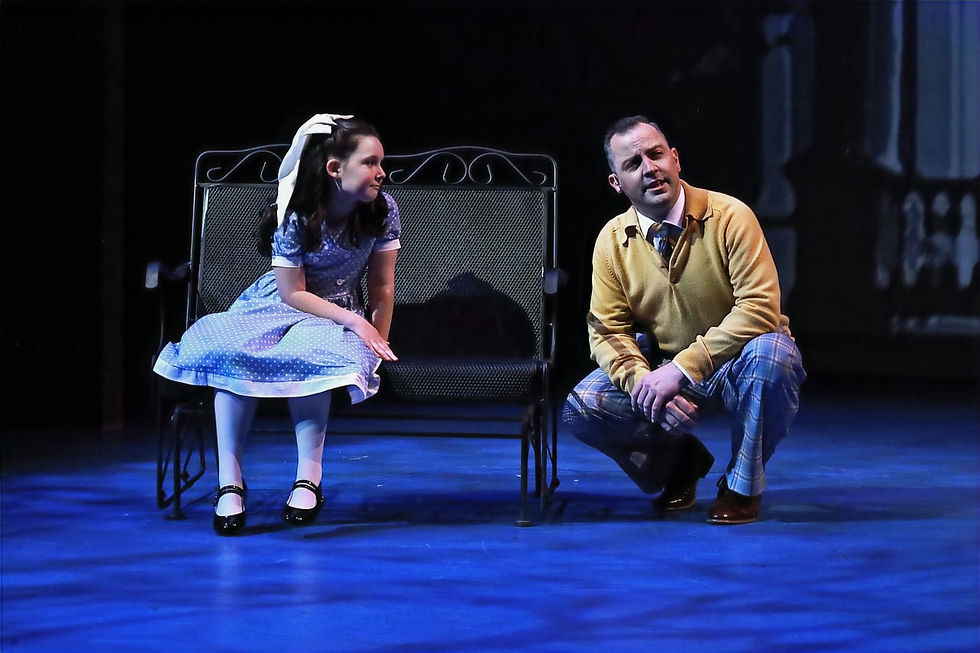
Child actor Arden Kacala conquers the stage as the general's granddaughter Susan, simply by being a sweet little girl. Her recreation of Martha's "Let Me Sing and I'm Happy" earns the biggest ovation of the evening. The secret of the performance is that there is nothing toxically showbizzy about this child; she is simply adorable and the audience responds with genuine warmth.
Kristen-Marie Lopez hilariously offers yet another sampling of her signature character types with hardboiled Tessie and Snoring Woman, creating fully realized comic portraits in limited stage time.
Matt Refermat delightfully milks the exasperated director bit for all its worth, mining every laugh from his put-upon character's mounting frustrations.
Bobby Cooke deadpans his way through Ezekiel Foster, the oddball stagehand who, Martha tells us, "came with the barn," turning what could be a throwaway role into a memorable presence, punctuated with an unexpected romantic subplot.
David Wysocki mines old Hollywood to embody the former army buddy turned TV producer Ralph Sheldrake, as powerful as he is clueless, capturing the blustery confidence of the era's media moguls.

The stage is populated with vivid personalities. It's fun to see Artie Award winner Dan Urtz doing a yeoman's job as a hoofer. Samantha Campbell, Jack Catena (channeling Bobby Banas), Thomas Evans, David P. Eve, Natasha McCandless, Alexandra Montesano, and Emily Weber – all are perfection, forming an ensemble that dances with precision and sings with the blended power that makes these production numbers soar.
Irving Berlin's White Christmas the Musical at MusicalFare makes no apologies for what it is: a sentimental celebration of an idealized America wrapped in some of the greatest popular songs ever written. Under Chris Kelly's direction, with Kristy Cavanagh's dazzling choreography and Theresa Quinn's lush musical direction, this production embraces its nostalgic heart with professional polish and genuine joy. If you want to spend an evening wrapped in the warm glow of Berlin's music, performed by a company that clearly loves what they're doing, this White Christmas delivers exactly what it promises.
Performances continue through December 21st.
Thursdays: 7:30 p.m.
Fridays: 7:30 p.m.
Saturdays: 3:00 p.m. and 8:00 p.m.
Sundays: 2:00 p.m.


